
Complete oral rehabilitation with ceramic restorations: how to restore a collapsed bite using adhesive cementation and rubber dam isolation
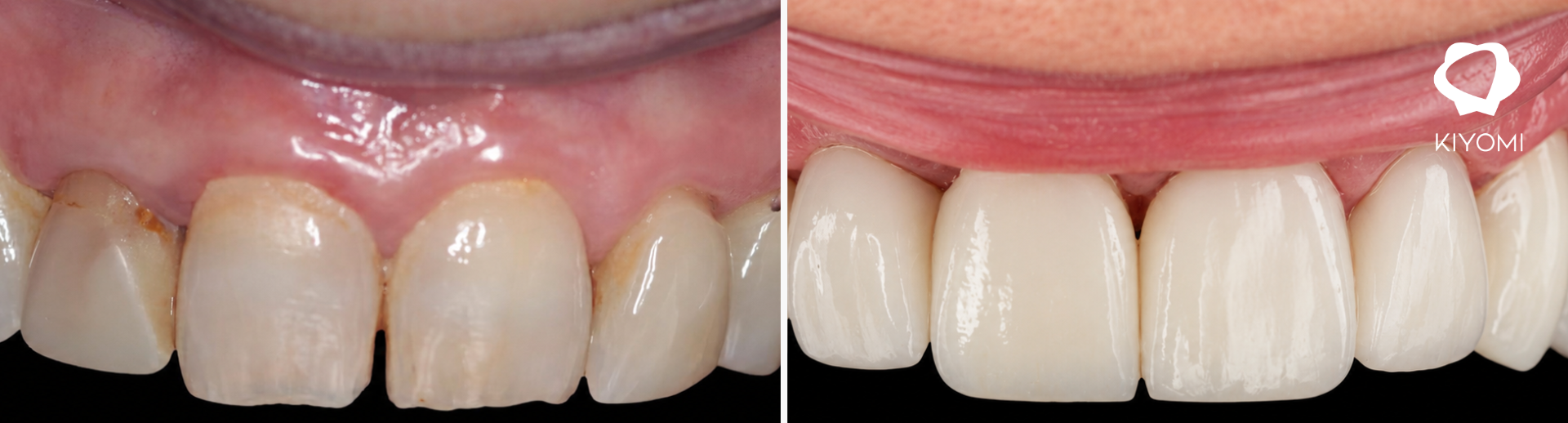
In advanced restorative dentistry, multidisciplinary cases represent one of the greatest clinical challenges. Deciding between veneers, inlays, crowns, bridges, or implants is not just an aesthetic matter: it involves restoring function, stability, and patient confidence through precise protocols and reliable materials.
This clinical case was carried out by Víctor Garcías from García&Pereira Clinic, where a collapsed bite rehabilitation was performed using partial ceramic restorations and the replacement of an upper bridge with adaptation issues. A complex treatment in which planning, isolation, and the selection of adhesive materials were decisive for the final success.
The clinical challenge: rehabilitating a collapsed bite with maximum precision
The patient presented with a collapsed bite and old restorations that required replacement with extreme care. In this type of treatment, preserving dental structure and ensuring marginal adaptation are essential to achieve long-lasting and functional results.
The selected solution consisted of:
- Partial ceramic restorations in layered lithium disilicate on all upper teeth.
- Replacement of the second quadrant zirconia bridge due to adaptation problems in the abutments.
- Selective adhesive cementation according to the thickness and mechanical requirements of each restoration.
This type of aesthetic and functional oral rehabilitation requires working under absolute isolation to avoid contamination and ensure maximum adhesion of resin cements.
Rubber dam isolation: the key to predictable adhesion
One of the most important steps of the procedure was isolation using the K-Rubber Dam system by Kiyomi Dental.
Absolute isolation remains essential in modern adhesive dentistry because it allows:
- Complete moisture control.
- Improved visibility of the operating field.
- Prevention of salivary contamination.
- Greater predictability in adhesive cementation procedures.
- Increased clinical longevity of restorations.
In this case, small-size B4 clamps stabilized using “stalactites” made with the K-Dam gingival barrier by Kiyomi Dental were used — a particularly useful technique in complex cases where isolation stability is critical.
Why choose the K-Rubber Dam isolation system by Kiyomi Dental?
K-Rubber Dam by Kiyomi Dental stands out for offering solutions designed to simplify complex clinical protocols without compromising precision.
Key advantages of the Kiyomi isolation system
- Excellent elasticity and resistance of the rubber dam.
- Improved cervical adaptation.
- Greater patient comfort.
- Optimization of clinical working times.
- Compatibility with advanced restorative and adhesive procedures.
- Highly stable gingival barriers with easy application.
For clinics looking to purchase professional dental isolation materials, working with reliable systems makes a real difference in daily clinical predictability.
DUAL-CEM by Kiyomi Dental: dual-cure cementation for maximum clinical safety
Dual-cure cements are especially recommended for indirect restorations where light transmission may be compromised, as occurs with zirconia or thicker restorations.
Key benefits of DUAL-CEM
- Dual polymerization to ensure complete curing.
- Excellent color stability.
- High adhesive strength.
- Easy clinical handling.
- Controlled flow to prevent excess material.
- Optimal adaptation in complex indirect restorations.
- Compatibility with modern adhesive protocols.
In addition, its A1 shade facilitates highly aesthetic integration in demanding rehabilitations.
For many professionals looking to purchase high-quality dual-cure dental cement, the combination of ease of use and predictable results has become a key factor when selecting restorative materials.
Multidisciplinary cases that demand experience and reliable materials
Redoing previous treatments always represents a clinical challenge. It not only involves correcting existing problems, but also restoring the patient’s confidence, function, and aesthetics through fully personalized treatments.
This case demonstrates how the combination of planning, absolute isolation, and high-quality restorative materials can transform complex rehabilitations into highly predictable outcomes.
In advanced restorative dentistry, choosing each material correctly is no longer just a technical matter: it is a strategic decision that directly impacts treatment durability and final patient satisfaction.
That is why more and more clinics trust solutions from Kiyomi Dental for their isolation, adhesion, and aesthetic cementation protocols.