
Dental aesthetics with resin: how to achieve natural, conservative and long-lasting restorations
Modern aesthetic dentistry is increasingly focused on conservative treatments that improve the smile while preserving as much natural tooth structure as possible. In this context, dental aesthetics with resin has become one of the most versatile alternatives for correcting imperfections, restoring damaged teeth and achieving highly aesthetic results.
Thanks to the evolution of dental composite resin, it is now possible to reproduce the colour, translucency and texture of natural teeth with great precision, obtaining restorations that are virtually imperceptible.
What is dental composite resin?
Dental composite resin is a restorative material made up of a resin matrix reinforced with filler particles that provide mechanical strength and excellent optical properties.
Its main advantage is that it enables minimally invasive treatments, as it bonds directly to the dental tissue and can be precisely shaped to reproduce the natural anatomy of the tooth.
Today, there are different types of composites depending on clinical needs. Among them, nanohybrid composites stand out, as they are widely used in aesthetic restorations due to their balance between strength, polishing ability and optical behaviour.
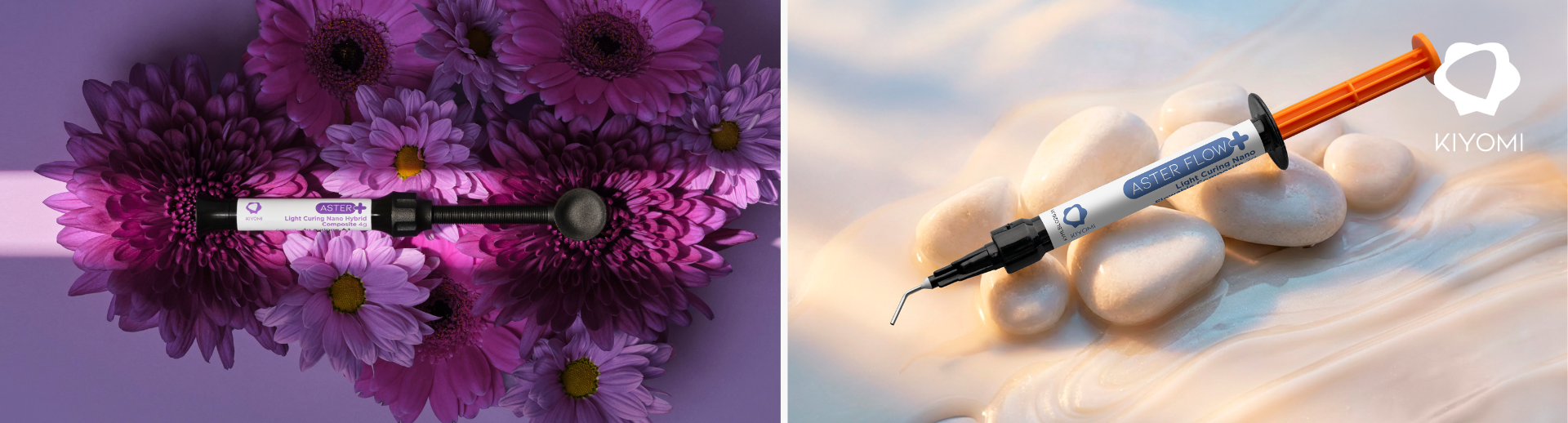
An example of this type of material is Aster+, Kiyomi Dental’s nanohybrid composite, developed for restorative procedures where the aim is to combine aesthetics and functionality. Its composition allows it to blend visually with dental tissue, which is especially important in visible restorations.
Composite veneers: a conservative solution to improve the smile
Composite veneers are one of the best-known applications of composite resin in aesthetic dentistry.
They consist of the direct application of composite layers onto the vestibular surface of the tooth to correct aesthetic alterations such as:
- Worn teeth.
- Minor fractures.
- Permanent stains.
- Shape alterations.
- Diastemas or spaces between teeth.
One of the reasons why composite veneers have gained popularity is that they usually require minimal or even no tooth preparation, allowing as much enamel as possible to be preserved.
In addition, today’s composites offer a wide range of shades and translucency levels that make it easier to reproduce the natural characteristics of the dentition.
Dental veneers before and after: the impact of proper planning
Dental veneer before-and-after cases show how small modifications can significantly transform the harmony of a smile.
However, the success of these treatments does not depend solely on the material used. Factors such as diagnosis, digital planning, correct shade selection and the layering technique are decisive in achieving natural results.
The evolution of modern composites has made it possible to improve aspects such as:
- Colour stability.
- Polishing ability.
- Wear resistance.
- Reproduction of the tooth’s natural fluorescence.
These characteristics help restorations maintain their aesthetic appearance for longer.
Porcelain or composite veneers: which option should you choose?
When considering an aesthetic rehabilitation, it is common to compare composite veneers with porcelain veneers.
Both alternatives can offer excellent results, although they present important differences.
Composite veneers
- More conservative procedure.
- Easy repair in the dental practice.
- Lower initial cost.
- Possibility of being completed in a single session.
Porcelain veneers
- Greater resistance to staining.
- Excellent long-term aesthetic stability.
- Greater durability in certain clinical cases.
- Require the involvement of a dental laboratory.
The choice will depend on factors such as the clinical situation, the patient’s expectations and the treatment plan established by the professional.
Which is more expensive, resin or porcelain?
A common question among patients is: which is more expensive, resin or porcelain?
In general, treatments performed with porcelain tend to have a higher cost due to the involvement of the dental laboratory, the manufacturing processes and the clinical time required.
For this reason, restorations carried out with composite usually represent a more economically accessible alternative, especially when looking for a conservative aesthetic solution.
However, cost should never be the only selection criterion, as each material offers specific advantages depending on the needs of the case.
Composite resin crown: when may it be indicated?
The composite resin crown still has clinical applications in certain situations.
Although ceramic restorations have experienced significant growth in recent years, crowns made with composites continue to be used as long-term provisional restorations or in certain restorative protocols where ease of repair is an important advantage.
The improvement of today’s composites has made it possible to considerably increase their mechanical and aesthetic performance compared with previous generations.
How long does an aesthetic dental resin last?
Another of the most common questions is: how long does an aesthetic dental resin last?
The answer depends on multiple factors:
- Quality of the material used.
- Restorative technique.
- Patient’s oral hygiene.
- Eating habits.
- Presence of bruxism.
- Regular check-ups.
With correct clinical execution and proper maintenance, restorations made with composite can retain their functional and aesthetic properties for many years.
In addition, one of the advantages of this material is that it allows conservative repairs to be carried out without the need to completely replace the restoration.
The evolution of composites in aesthetic dentistry
The continuous improvement of restorative materials has greatly expanded the possibilities of adhesive dentistry. Today, nanohybrid composites such as Aster+ by Kiyomi Dental are part of a generation of materials designed to offer a balanced combination of strength, polishability and natural aesthetics.
Thanks to these advances, treatments such as composite veneers, direct restorations or certain rehabilitations using composite resin crowns can be performed with an increasingly conservative and predictable approach.
Dental aesthetics with resin continues to evolve towards less invasive, more personalised procedures capable of delivering natural results that respect the original tooth structure, one of the fundamental principles of modern dentistry.