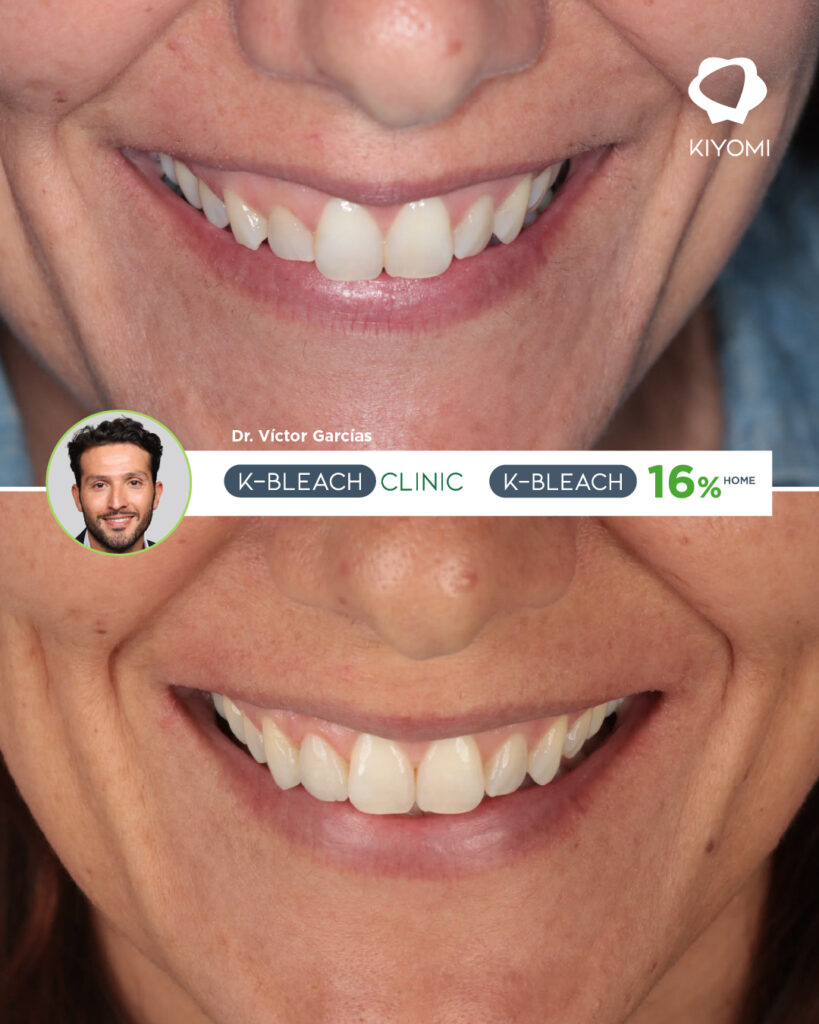
How much can a smile change with a simplified treatment? This clinical case combines teeth whitening with K-Bleach by Kiyomi Dental and two composite restorations, achieving a result that the clinician describes as a completely different smile.
Beyond the aesthetic change, the case invites reflection on planning in restorative dentistry: taking time to observe, identifying needs and assessing which interventions can deliver a meaningful improvement.
The clinician introduces the case with a humorous reflection: “I’m becoming a ‘Buddhist’: every day, I’m content with less.” A way of expressing an idea that runs throughout the treatment: seeking a satisfying result through a limited, carefully planned intervention.
A conservative approach that begins with observation
The clinician’s satisfaction stems both from the outcome and from the simplicity of the treatment performed. His reflection highlights the importance of taking time, observing carefully and applying the clinical judgement that comes with experience.
From this perspective, simplifying treatment requires an understanding of what each case needs. The decision on how much to intervene arises from that assessment, helping to guide treatment towards specific goals.
In this case, the approach described involves just two procedures: whitening with K-Bleach and the placement of two composite restorations. This combination was enough to achieve the smile transformation highlighted by the clinician.
Teeth whitening with K-Bleach by Kiyomi Dental
Teeth whitening with K-Bleach is one of the central elements of this case. The clinician incorporates this Kiyomi Dental product into an aesthetic treatment completed with two restorations.
What makes the case interesting is how both procedures are integrated into a single treatment plan. The outcome is presented as the combined effect of the treatment, so the entire transformation cannot be attributed to either procedure alone.
The information shared does not specify which K-Bleach formulation was used or provide details of the application protocol. This case therefore focuses on the clinical approach and the outcome described by its author.
Two restorations to complete the aesthetic transformation
Alongside the whitening treatment, two additive composite restorations were placed. This detail underpins the message of the case: a localised intervention can contribute to a significant aesthetic change when it addresses the needs identified during assessment.
The author does not specify the teeth treated, the restorative material or the technique used. What he does emphasise is his deep satisfaction with the change achieved through this combination of treatments.
The case should be interpreted within that scope: it documents a specific clinical experience without establishing a protocol applicable to every smile.
Dental aesthetics: the value of simplifying with clinical judgement
One of the most interesting aspects of this clinical case involving K-Bleach is the relationship between observation and treatment. The clinician’s reflection places a keen clinical eye at the heart of simpler treatment planning.
Simplifying with clinical judgement means choosing the interventions that make sense for each case. The number of procedures performed does not, on its own, explain the value of an outcome. The ability to recognise needs and the precision with which treatment is planned also matter.
Here, whitening with K-Bleach and two additive composite restorations illustrate this treatment philosophy: two complementary procedures that, according to the clinician, achieved a completely different smile.
A different smile through limited treatment
This case of teeth whitening with K-Bleach by Kiyomi Dental and two restorations using ASTER+ composite by Kiyomi Dental highlights an approach to dental aesthetics based on observation and the careful selection of interventions.
The author’s satisfaction captures the value of this approach: taking time to assess a case and finding a simplified solution can be an essential part of clinical practice. An invitation to look at each smile carefully and let its needs guide the treatment.