
Treatment of Mild Dental Fluorosis and Post-Orthodontic Iatrogenesis: Macro-Whitening and Enamel Macro/Microabrasion with Kiyomi
Dentists must be prepared to confidently present the different alternatives to oral health problems faced by the population seeking their knowledge, skills, empathy and responsibility.
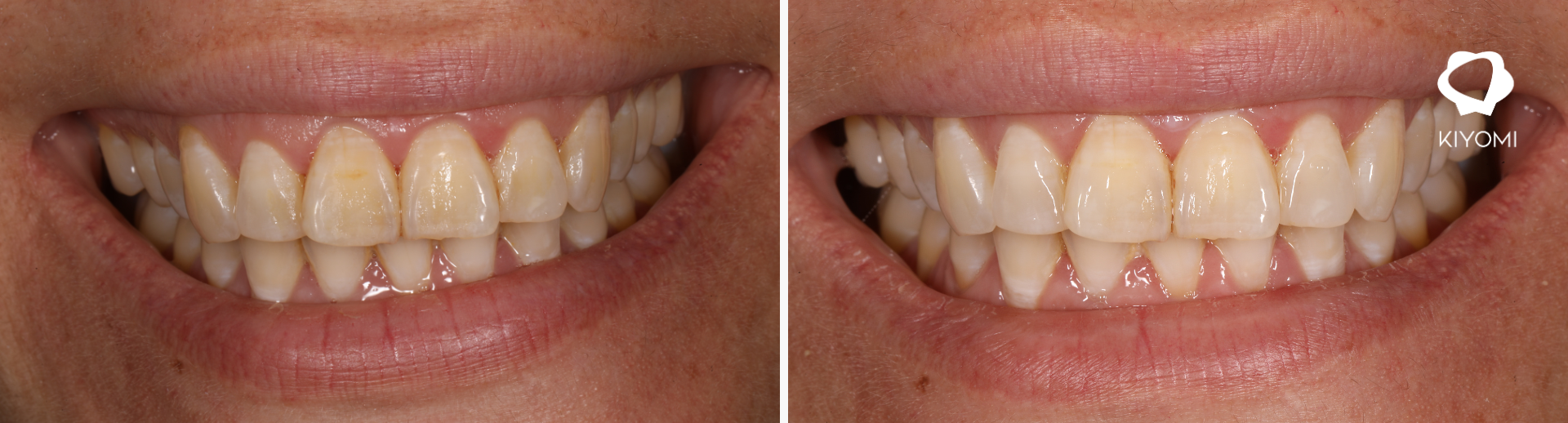
In this clinical case, a patient presented with mild dental fluorosis and an enamel surface damaged by the incorrect removal of residual orthodontic cement. The clinical situation was addressed with a highly conservative and minimally invasive approach, providing effective and long-lasting solutions according to the patient’s chief complaint.
The treatment also had to solve both problems in a single appointment, as requested by the patient.
What is dental fluorosis and how can it be treated?
Dental fluorosis is a developmental alteration of enamel with high global prevalence. It is caused by the presence of high levels of fluoride dissolved in drinking water, affecting the mineralization of the enamel tissue.
Its main impact is aesthetic, often affecting the patient’s self-esteem. Fortunately, it can be treated using minimally invasive procedures without resorting to veneers or extensive and destructive restorations.
This condition is characterized by:
- Diffuse opacities, usually white in mild to moderate stages
- Loss of enamel continuity in moderate to severe cases
- Loss of enamel structure and dark stains in moderate to severe stages
Today, dentistry offers several alternatives to address the challenges presented by dental fluorosis. From a minimally invasive perspective, these include:
- Professional dental whitening
- Enamel macro- and microabrasion
- Combined procedures with a conservative approach
These techniques significantly improve dental appearance without unnecessary enamel removal or invasive restorations.
Post-orthodontic iatrogenesis: How can it be managed?
Orthodontic treatment is perhaps the clinical procedure that provides the most conservative and natural smile design for patients. However, achieving optimal results requires careful professional supervision and active patient participation in hygiene, care and consistency.
This treatment begins when the patient seeks to correct a malocclusion through proper diagnosis and clinical evaluation. It involves bonding orthodontic attachments onto healthy enamel and ends with the correct removal of all cement residues, restoring the enamel’s original smoothness and gloss.
When this procedure is performed incorrectly and with inadequate instruments, the enamel surface may become irregular, opaque and damaged, making it more prone to biofilm accumulation and pigmentation. The result is compromised enamel, visible staining and inflamed, bleeding gingiva.
Among the instruments not recommended for this procedure is the Arkansas stone, as it cannot produce a smooth, polished surface without damage. Diamond stones or any instruments that can harm the enamel surface should also be avoided. It is strongly recommended to follow clinically validated techniques and procedures described in scientific literature.
Treatment plan: Improving aesthetics in a single session
The treatment strategy focused on a conservative aesthetic protocol performed in a single appointment, responding to an increasingly common demand: improving dental aesthetics once the patient understands the treatment options supported by scientific evidence.
Since the patient could not attend multiple appointments, the clinical objective was to achieve the greatest possible aesthetic improvement in a single visit.
The protocol was structured in two complementary phases:
- Clinical whitening: two applications with 35% hydrogen peroxide
- Enamel macro- and microabrasion
Professional in-office dental whitening
In-office dental whitening was performed using two consecutive 15-minute applications of Kiyomi’s professional system with 35% hydrogen peroxide.
Its main clinical advantages include:
- High effectiveness in short treatment times
- Controlled whitening process
- Preventive management of dentin hypersensitivity
- Visible and long-lasting results
The whitening procedure helped equalize the overall enamel shade, reducing the contrast caused by fluorosis stains and other pigments.
Enamel macro- and microabrasion
After the initial whitening phase, enamel macro- and microabrasion were performed. These techniques are indicated for managing enamel developmental alterations such as dental fluorosis and for eliminating diffuse opacities and scratches caused by incorrect removal of orthodontic cement.
This procedure allowed:
- Restoration of enamel surface gloss
- Reduction of residual optical defects
- Improved light reflection
- Enhancement of the final aesthetic result
The use of Kiyomi systems from IPG Dental ensured precise control of the treatment while preserving healthy dental structure.
Advantages of using Kiyomi products in aesthetic dental treatments
One of the key aspects of this case was working with a comprehensive aesthetic dentistry system, where all materials are designed to function synergistically.
Kiyomi products from IPG Dental provide:
- Simplified clinical protocols
- High aesthetic predictability
- Optimized chair time
- Natural results without invasive treatments
- Effective solutions for single-visit treatments
For dental clinics, this translates into greater operational efficiency, high patient satisfaction and the ability to offer differentiated aesthetic services, especially fast and effective treatments.
Clinical results obtained
The treatment achieved:
- Immediate improvement in dental aesthetics
- Visible reduction of fluorosis stains
- A more homogeneous enamel surface
- A brighter and more natural smile
- Completion of the treatment in a single appointment
All of this was accomplished through a minimally invasive and biologically respectful approach.
Efficient aesthetic dentistry: Less invasion, better results
This clinical case demonstrates how the combination of proper diagnosis, conservative techniques and high-performance materials can successfully resolve common aesthetic alterations such as mild dental fluorosis, even when clinical time is limited.
Today, treatments such as professional whitening combined with microabrasion represent an effective alternative to more aggressive solutions, aligning with the current trend toward conservative and predictable aesthetic dentistry.
Thanks to solutions like Kiyomi by IPG Dental, it is possible to offer fast, safe and highly demanded treatments for patients who wish to improve their smile without invasive procedures.
Procedure performed by Dr. Alfredo Natera