
Adhesive Cementation of Lithium Disilicate Crowns: Step-by-Step Clinical Protocol Using Kiyomi Adhesive Systems
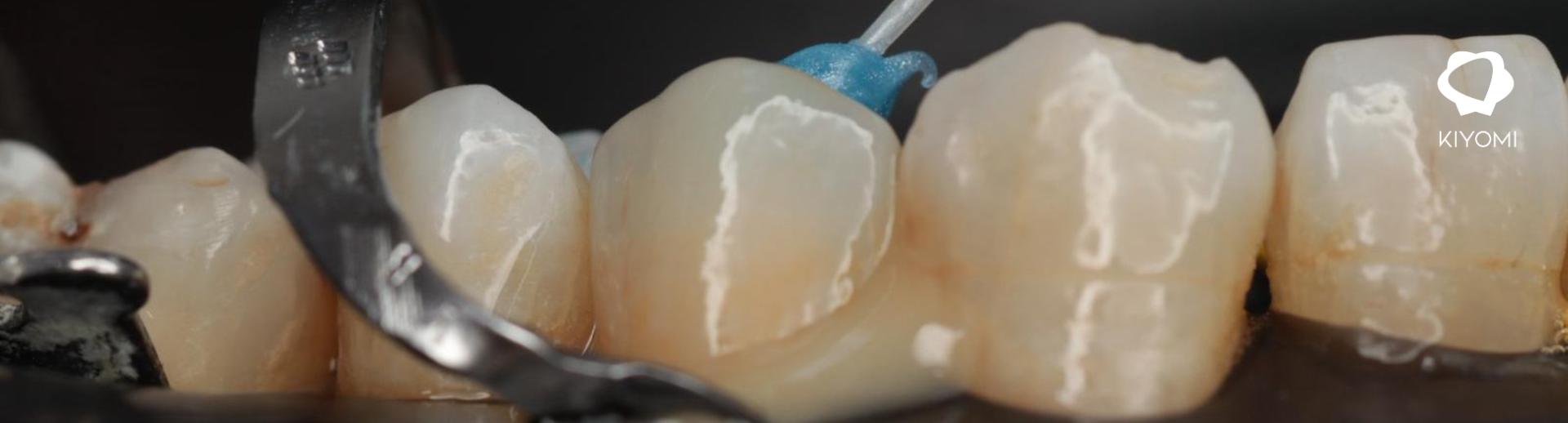
Adhesive cementation of lithium disilicate crowns has become one of the most predictable restorative procedures in modern restorative dentistry. Proper material selection and strict adherence to the clinical protocol are decisive factors for achieving durable adhesion, optimal marginal sealing, and high-level aesthetic outcomes.
In this clinical article, we present the adhesive cementation protocol performed by Dr. Victor Garcias, using the adhesive system in combination with Kiyomi Dental’s Dual Cem resin cement. The article highlights the advantages compared with conventional systems available on the market and explains the clinical reasons why it is increasingly becoming the preferred choice for clinics seeking high-performance restorative dental materials.
Why choose adhesive cementation for lithium disilicate crowns?
When adequate isolation is achieved, adhesive cementation allows:
- Greater mechanical and chemical retention of the restoration
- Superior marginal sealing
- Improved long-term aesthetic outcomes
- Reduced risk of microleakage
For these reasons, many clinicians opt for complete adhesive protocols using state-of-the-art etching, bonding, and dual-cure cementation systems.
Step-by-step clinical adhesive cementation protocol
Crown conditioning
Internal conditioning of the lithium disilicate restoration was performed using a protocol that included etching with 9.5% hydrofluoric acid for 20 seconds, followed by rinsing with phosphoric acid (K-Etch 37% by Kiyomi Dental), which helped neutralize and remove residual hydrofluoric acid used for conditioning the lithium disilicate glass surface.
Pure silane was then actively rubbed onto the surface for 20 seconds and air-dried for another 20 seconds to allow volatilization. Finally, the K-Bond+ Universal adhesive system was applied without light curing, and the procedure was completed with the application of the definitive Dual Cem resin cement by Kiyomi Dental.
Tooth conditioning
Conditioning of the tooth preparation was carried out by etching with phosphoric acid (K-Etch 37%) for 15 seconds, followed by the application of the K-Bond+ Universal adhesive system without light curing. The crown, previously loaded with Dual Cem, was then seated, and excess cement was removed using dental floss and a brush.
Light curing
Initial light curing was performed with a 2-second tack-curing phase on the buccal side and 2 seconds on the palatal side, after which residual cement was removed using a No. 12 scalpel blade.
Final polymerization was then performed by applying glycerin to the margins and light curing for 40 seconds per surface to optimize monomer conversion.
Differential advantages of Kiyomi adhesive and cementation systems compared with other materials on the market
The products used in this protocol stand out from competing alternatives for several key reasons:
- Optimized material compatibility
The complete Kiyomi system (K-Etch 37%, K-Bond+ Universal, and Dual Cem) is designed to function in an integrated manner, reducing clinical variability and improving adhesive predictability. - True universal adhesion
K-Bond+ Universal allows bonding to multiple substrates (enamel, dentin, etchable ceramics, and non-etchable materials such as zirconia, metal, etc.), eliminating the need for multiple dedicated adhesives. - Dual-cure cement with high color stability
Dual Cem provides excellent color stability and superior mechanical properties, particularly relevant in highly aesthetic restorations, delivering the reliability every clinician seeks. - Simplified clinical workflow
The combined system reduces unnecessary steps and facilitates reproducible protocols, especially valued in clinics seeking efficient and easy-to-use dental materials.
Conclusion
Adhesive cementation of lithium disilicate crowns requires technical precision and top-quality materials. The combination of an appropriate clinical protocol with adhesive systems designed to work in an integrated manner such as those from Kiyomi Dental enables more stable, aesthetic, and long-lasting restorations.
Choosing reliable materials not only improves clinical outcomes but also optimizes workflow efficiency and treatment predictability—factors that are increasingly decisive in contemporary restorative dentistry.