

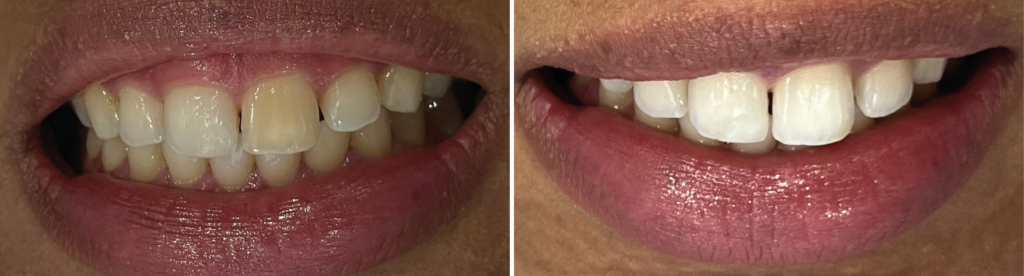
Dr Irene Boullosa presents the clinical case of a 22-year-old patient who attended the clinic concerned about the progressive darkening of an anterior incisor. The tooth discoloration was her main concern, as it affected the aesthetic harmony of her smile.
Following a complete clinical and radiographic examination, Dr Irene Boullosa diagnosed pulp calcific metamorphosis, also known as root canal obliteration. The tooth showed no symptoms or signs of periapical pathology.
Given the absence of pain and the almost complete obliteration of the canal, endodontic treatment was initially ruled out. Instead, a more conservative alternative was selected: a combined external tooth whitening protocol, carried out both in-office and at home.
Diagnosis of the darkened incisor
During the examination of the anterior incisor, the following findings were observed:
- Progressive darkening of the dental crown.
- Absence of spontaneous pain.
- Absence of pain on percussion.
- Negative response to the cold sensitivity test.
- Almost complete obliteration of the root canal.
- Absence of apical periodontitis.
A lack of response to sensitivity tests can be common in teeth affected by calcific metamorphosis and, on its own, does not necessarily indicate the need for root canal treatment.
In this case, the tooth remained asymptomatic and the periapical tissues appeared radiographically healthy. For this reason, Dr Irene Boullosa opted for a minimally invasive alternative that could improve the tooth shade without removing dental tissue or accessing the root canal system.
Treatment with combined tooth whitening
The treatment involved a combination of professional in-office whitening and an at-home protocol using custom-made trays.
During the first appointment, an intraoral scan was performed to produce the trays for at-home tooth whitening.
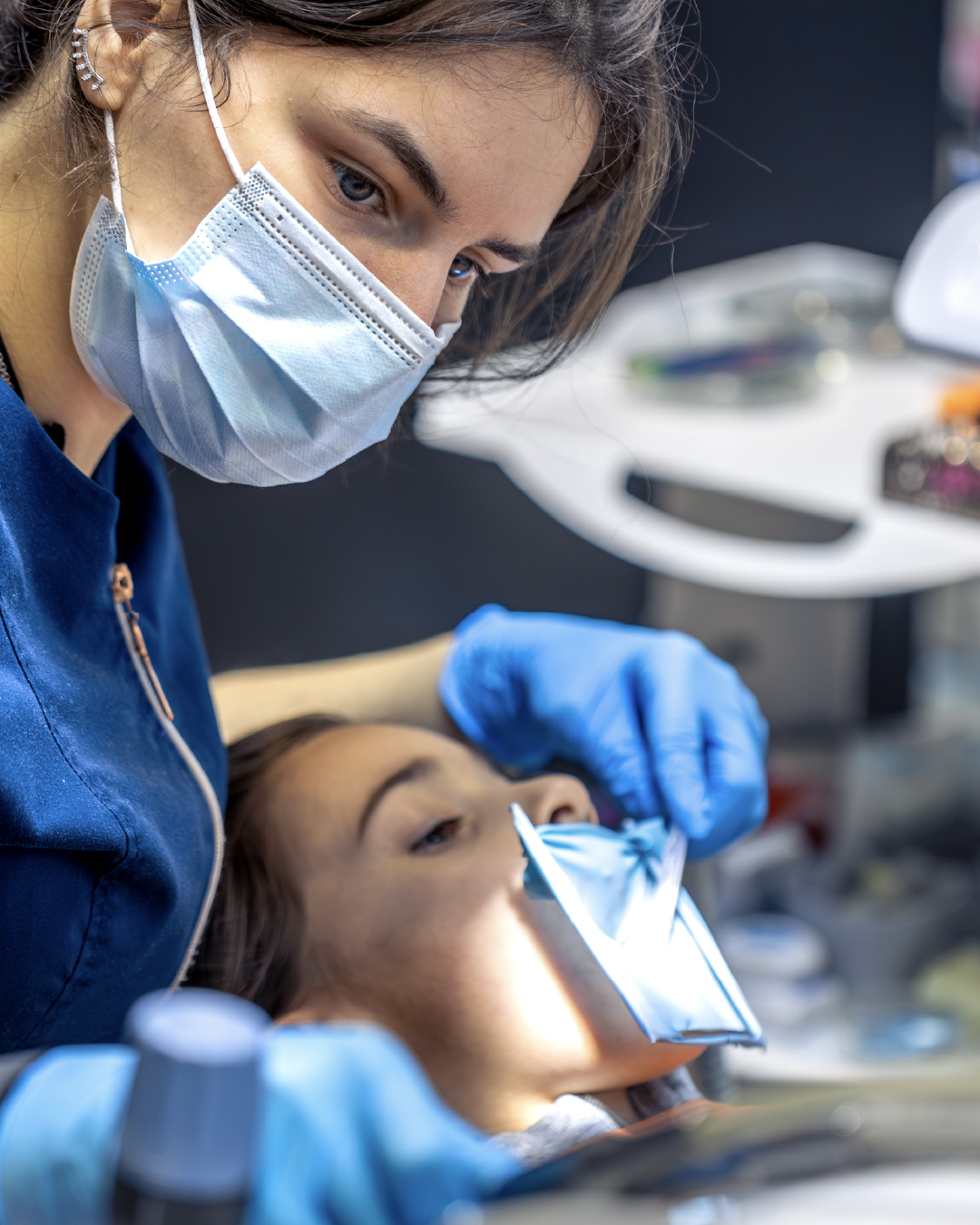
At the second appointment, professional in-office whitening was carried out under rubber dam isolation in order to adequately protect the soft tissues and control the application of the whitening gel.
The protocol performed by Dr Irene Boullosa included:
- Placement of a rubber dam.
- Protection of the soft tissues with K-DAM by Kiyomi Dental.
- Application of K-BLEACH CLINIC whitening gel.
- Three consecutive 15-minute cycles.
- Delivery of the custom-made trays.
- Delivery of two syringes of gel to complete the at-home treatment.
The combination of both phases made it possible to carry out a progressive and controlled treatment adapted to the specific characteristics of the darkened tooth.
K-DAM: gingival barrier for tooth whitening
K-DAM is a light-curable gingival barrier designed to protect the soft tissues during professional tooth whitening procedures.
One of its main characteristics is its high thixotropy, which facilitates precise application and helps keep the product in the desired area without flowing or spreading into other parts of the operating field.
Its main advantages include:
- Direct and controlled application.
- Good sealing and protection of the soft tissues.
- High thixotropy.
- Rapid light-curing.
- Easy removal once the treatment has been completed.
These characteristics make K-DAM a suitable solution for professionals looking for a gingival barrier that is easy to handle and adapts well to the clinical field during tooth whitening procedures.
K-BLEACH CLINIC: 35% professional whitening gel
K-BLEACH CLINIC is a professional tooth whitening system formulated with 35% hydrogen peroxide, specifically developed for in-office treatments.
In the case presented by Dr Irene Boullosa, three consecutive 15-minute applications produced a visible whitening effect from the very first session.
The main distinguishing features of K-BLEACH CLINIC include:
- 35% hydrogen peroxide.
- Dual-syringe system for a homogeneous mixture.
- Controlled dispensing to reduce product waste.
- 0.1% hydroxyapatite nanoparticles.
- Vitamin E.
- Clinical protocol based on 15-minute cycles.
K-BLEACH CLINIC is indicated for dentists looking for a professional whitening gel with controlled application and a simple, fast and effective clinical protocol.
Tooth whitening results
At the review appointment two weeks after treatment, a noticeable aesthetic improvement was observed.
The incisor changed from an initial A3.5 shade to A1, according to the VITA Classical shade guide. The patient reported a high level of satisfaction with the result and experienced no tooth sensitivity or other treatment-related complications.
Three months later, Dr Irene Boullosa carried out a new clinical and radiographic review, which confirmed that:
- The achieved shade remained stable.
- The patient remained asymptomatic.
- The periapical tissues remained radiographically healthy.
- There were no signs of apical periodontitis.
The stability of the result and absence of complications supported the choice of a conservative treatment for this case.
A conservative alternative for darkened teeth
The clinical case carried out by Dr Irene Boullosa shows how combined external tooth whitening can be a conservative alternative for teeth affected by calcific metamorphosis, provided that they show no symptoms or periapical pathology.
The combined use of K-DAM as a gingival barrier and K-BLEACH CLINIC as a professional whitening gel made it possible to improve the shade of the incisor without performing dental preparation or accessing the root canal.
This approach helped preserve dental tissue while addressing the patient’s main aesthetic concern through a minimally invasive procedure.
Professionals interested in incorporating solutions for professional tooth whitening can explore the Kiyomi Dental range, which includes products for in-office treatments, at-home protocols and soft-tissue protection.
Clinical note: treatment indication should be established following a complete clinical and radiographic examination. Teeth affected by calcific metamorphosis should undergo regular follow-up to assess their progression and detect any possible clinical or periapical changes.