

A restoration may have excellent anatomy, a precise fit and flawless shade integration. However, its clinical performance also depends on an area that is barely visible to either the patient or the human eye: the interface between the restoration and the dental structure.
A significant part of the treatment’s stability, sealing and final integration depends on this minimal space. For this reason, choosing between different aesthetic dental cements should not be considered a secondary decision or be based solely on selecting a shade.
The cement must respond appropriately to the restorative material, the thickness of the restoration, light transmission, mechanical requirements and the adhesive protocol used. Aesthetics matter, but they must be supported by adequate polymerisation, reliable bonding and predictable clinical handling.
Resin cements stand out precisely because they combine optical properties, adhesive capacity and mechanical strength—qualities that are particularly important when cementing indirect restorations.
What Are Permanent Aesthetic Dual-Cure Dental Cements?
Aesthetic dental cements are materials used to retain indirect restorations while preserving the optical harmony of the combination formed by the tooth, the cement and the restoration.
Depending on their composition and polymerisation system, they can be used in treatments such as:
- Crowns and bridges.
- Inlays, onlays, overlays and endocrowns.
- Lithium disilicate restorations.
- Zirconia restorations.
- Indirect composite restorations.
- Fibre-post cementation.
- Pre-endodontic build-ups.
- Prosthetic and implant interfaces.
The purpose is not simply to “bond” a restoration. The cement must complete the restorative protocol, promote a stable bond, properly fill the interface and withstand the functional conditions of the oral cavity over time.
Why Can the Choice of Cement Change the Outcome?
In adhesive dentistry, there is no single cement suitable for every situation. The so-called best dental cement is, in reality, the one that responds correctly to the specific variables of each clinical case.
The Restorative Material
The behaviour of a zirconia restoration is not the same as that of a lithium disilicate, metal-ceramic, composite or glass-fibre restoration.
Each substrate has different characteristics and may require specific surface conditioning and an appropriate adhesive protocol. Therefore, before selecting a cement for zirconia crowns or a cement for lithium disilicate, it is necessary to assess the complete restorative system and follow the instructions provided by the manufacturers involved.
Light Transmission
The thickness, opacity and material of the restoration determine how much light reaches the cement.
When light transmission through the restoration is limited, a dual-cure resin dental cement provides an important clinical advantage: it combines light-curing with chemical activation to promote polymerisation in deep areas or areas that are difficult for the curing light to reach.
In very thin and translucent restorations, such as certain ceramic veneers, clinicians should pay particular attention to colour stability. Available evidence indicates that exclusively light-cured cements may offer greater colour stability than some dual-cure cements in thin ceramic restorations.
Mechanical Requirements
A posterior restoration subjected to high loads does not have the same requirements as a highly translucent anterior restoration.
Mechanical strength, structural stability and bonding quality are particularly important in extensive build-ups, post cementation, endocrowns and posterior restorations.
Clinical Handling
The application of the cement directly affects control over the procedure.
An appropriate consistency, a homogeneous mixture and a precise dispensing system help to:
- Reduce proportioning errors.
- Prevent the incorporation of air bubbles.
- Improve the seating of the restoration.
- Facilitate placement in deep areas.
- Control the removal of excess material.
- Make the protocol more reproducible.
Light-Cured Cements and Dual-Cure Cements: When Should Each Be Used?
Light-cured cements polymerise through exposure to light. They provide a controllable working time and are generally considered especially suitable for thin, translucent restorations through which light can pass effectively.
Dual-cure cements combine two polymerisation mechanisms:
- Light activation or photopolymerisation.
- Chemical activation or self-curing.
This combination provides additional reliability in thick, opaque or deep restorations where it cannot be guaranteed that light will reach every area of the cement with the same intensity.
For this reason, dual-cure cement is frequently used for crowns, bridges, posterior restorations, endocrowns, posts and other situations in which depth or geometry may limit light-curing.
The choice should not be based solely on personal preference. It must respond to the diagnosis, the restoration, the substrate and the specific indications of the material.
Kiyomi Dental Cements: Two Solutions for Different Needs
Kiyomi Dental has structured its cementation range around two clearly differentiated products: Dual Cem and Dual Cem Core.
These are not two interchangeable versions of the same cement. Each one responds to a different clinical need:
- Dual Cem is primarily intended for the permanent adhesive cementation of indirect restorations.
- Dual Cem Core combines adhesive cementation and structural build-up in procedures requiring high strength, control and mechanical stability.
This distinction makes it easier for professionals to identify which material is best suited to each stage of treatment.
Dual Cem: Dual-Cure Resin Cement for Indirect Restorations
Dual Cem by Kiyomi Dental is a permanent dual-cure resin cement developed to provide safe and predictable adhesive cementation.
Its dual-curing system combines light activation and chemical activation. This enables the material to polymerise both in areas directly accessible to light and in areas where the restoration reduces light transmission.
It is indicated for the cementation of:
- Crowns.
- Bridges.
- Inlays.
- Onlays.
- Overlays.
- Endocrowns.
- Dental fragments.
- Fibre posts.
- Implant interfaces.
It can also be used for deep pre-endodontic build-ups and deep margin elevation, extending its applications beyond conventional prosthetic cementation.
Compatibility with Different Materials
One of its main advantages is that it can be used with a wide range of restorative materials, including:
- Zirconia: 3Y, 4Y, 5Y, multilayer, monolithic and layered.
- Lithium disilicate: pressed and milled.
- Metal: cobalt-chromium and titanium, including pre-sintered and milled materials.
- Metal-ceramic.
- Feldspathic ceramic.
- Composite.
- Hybrid materials.
- Glass fibre.
- Polyethylene fibres.
This versatility reduces the need to keep different cements for each type of restoration, provided that the corresponding adhesive protocol is followed.
Automatic Mixing in a 1:1 Ratio
Dual Cem is supplied in a dual-barrel syringe that dispenses the base and catalyst in a 1:1 ratio.
The automixing system produces a homogeneous consistency and helps prevent errors associated with manual proportioning. It also reduces the incorporation of air bubbles and promotes more consistent behaviour throughout the procedure.
Shades for Predictable Aesthetic Integration
It is available in four shades:
- A1.
- A2.
- A3.
- Translucent.
This range allows the shade to be selected according to the characteristics of the restoration and the desired optical result. Each presentation contains 5 grams of product.
Dual Cem Core: Build-Up and Cementation in a Single System
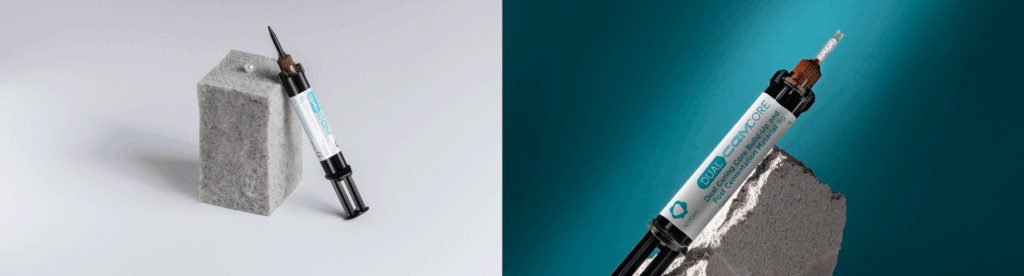
Dual Cem Core is a permanent, high-strength dual-cure resin cement designed for procedures in which cementation must be combined with structural reconstruction.
Its main indications include:
- Core build-ups.
- Deep margin elevation.
- Adhesive cementation.
- Cementation of intraradicular elements.
- Intraoral and root-canal applications.
Its dual-curing system ensures polymerisation through both light and chemical activation, providing greater reliability in deep areas and preparations where light access is limited.
Creamy Consistency and Controlled Application
The smooth, creamy consistency of Dual Cem Core facilitates material placement, adaptation to the preparation and control during build-up procedures.
It is supplied in a 9-gram dual-barrel syringe with an automixing system. The 30 intraoral and root-canal tips allow the application to be adapted to different clinical scenarios without changing materials.
Strength and Stability Under Load
Dual Cem Core is formulated to provide high mechanical strength and a stable foundation for the subsequent restoration.
This is particularly relevant in teeth with significant structural loss, core build-ups and areas subjected to demanding occlusal forces.
Radiopacity for Clinical Follow-Up
Its radiopaque formulation makes the material easier to identify on radiographs and enables clearer assessment of the postoperative result.
It is available in a universal shade, which is consistent with its focus on structural and restorative procedures.
Dual Cem or Dual Cem Core: Which Should You Choose?
| Clinical need | Dual Cem | Dual Cem Core |
|---|---|---|
| Cementation of crowns and bridges | Yes | Depending on the procedure |
| Inlays, onlays, overlays and endocrowns | Yes | Depending on the procedure |
| Material: zirconia, metal, composite, hybrid materials and lithium disilicate | Yes | Refer to the protocol |
| Cementation of glass fibre posts | Yes | Yes |
| Core build-ups | Specific applications | Main indication |
| Margin elevation | Not its main indication | Yes |
| Application in root canals | Yes, depending on the procedure | Yes, with specific tips |
| Different shades | A1, A2, A3 and Trans | Universal shade |
| Presentation | 5 g dual-barrel syringe | 9 g dual-barrel syringe |
| High radiopacity | Yes | Yes |
The selection should be based on the main objective of the treatment.
When the priority is the integration of an indirect restoration and shade selection, Dual Cem provides a more specific solution.
When the case requires reconstruction, margin elevation or the creation of a strong foundation, Dual Cem Core is better suited to the structural requirements.
What Makes Kiyomi Dental Cements Different?
In a market with numerous cements and protocols, adding more options does not always make decision-making easier.
The differentiating value of Kiyomi Dental lies not only in offering a dual-cure cement, but also in organising its range around recognisable clinical situations.
An Easy-to-Understand Range
Dual Cem and Dual Cem Core have clearly defined primary functions. This structure reduces overlap between products and helps professionals select the material according to the objective:
- Cementing an indirect restoration.
- Cementing and rebuilding a compromised structure.
Versatility Without Complicating the Protocol
Dual Cem can be used with different restorative materials and different types of indirect prosthetic restorations.
Dual Cem Core extends the available applications to include core build-ups, margin elevation and intraradicular procedures.
Professionals can cover numerous clinical scenarios with two differentiated systems, avoiding an excessively fragmented product range.
Automixing Systems
Both products use dual-barrel syringes that promote homogeneous mixing and controlled dispensing.
With Dual Cem, the precise 1:1 ratio of base and catalyst helps maintain a consistent material composition. With Dual Cem Core, the intraoral and root-canal tips facilitate application in areas that are difficult to access.
Aesthetics and Structure Within the Same Philosophy
Dual Cem offers four shades to meet the optical requirements of indirect restorations.
Dual Cem Core prioritises strength, radiopacity and structural stability.
Each product concentrates its characteristics on the result it is intended to provide, rather than presenting a single solution as a universal answer.
Protocols Designed for Everyday Practice
Kiyomi Dental defines its philosophy as “Excellence Made Easy”: integrating aesthetic and restorative dental materials through simple, effective and reproducible procedures.
The brand belongs to IPG Dental Group and complements its products with specialist advice and professional support, which is particularly valuable when introducing new restorative protocols into the dental clinic.
How to Select a Dental Cement for Your Clinic
Before purchasing a resin dental cement, it is worth considering five questions:
1. Which Material Is Going to Be Cemented?
Zirconia, lithium disilicate, composite, metal and glass fibre have different requirements.
2. How Much Light Can Pass Through the Restoration?
The thickness and opacity determine whether light-curing will be sufficient or whether a dual-cure system is advisable.
3. Is the Priority Aesthetics, Retention or Reconstruction?
A thin anterior restoration does not require the same product as a severely compromised core.
4. Which Adhesive Protocol Does the Case Require?
The cement is part of a complete system. The conditioning of the tooth, the treatment of the restoration and the stated compatibilities must all be respected.
5. Does the Application System Facilitate Control?
Automixing, material consistency and the available tips can improve clinical precision and reproducibility.
FAQ About Aesthetic Dental Cements
Which dental cement is used for zirconia crowns?
```Resin cements compatible with zirconia may be used, provided that the restoration is properly conditioned and the recommended adhesive protocol is followed.
Dual Cem is indicated for the cementation of zirconia restorations and combines light curing and chemical curing.
Which cement is recommended for lithium disilicate?
```The choice depends on the thickness, translucency and type of restoration.
For restorations where light transmission may be limited, a dual-cure cement can provide greater curing reliability. For very thin and highly translucent restorations, the clinician should assess colour stability and whether a light-cure cement would be more suitable.
Dual Cem is compatible with lithium disilicate restorations.
What is a dual-cure dental cement used for?
```A dual-cure cement combines light and chemical activation. It is particularly suitable when light cannot adequately reach certain areas, such as thick restorations, opaque crowns, posts or deep areas.
Can Dual Cem also be used for fibre posts?
```Yes. Dual Cem is indicated for the cementation of glass fibre posts. Dual Cem Core can also be used for intraradicular procedures and includes specific tips to facilitate application.
What is the difference between Dual Cem and Dual Cem Core?
```Dual Cem is primarily intended for the aesthetic and adhesive cementation of indirect restorations. Dual Cem Core is designed for core build-ups, margin elevation and procedures requiring high structural strength.
Where can Kiyomi Dental cements be purchased?
```Dental professionals can purchase Dual Cem and Dual Cem Core through IPG Dental, the distributor of Kiyomi Dental products for dental clinics and professionals.