
Tooth Whitening Without Sensitivity: The Key to a Perfect Smile This Summer
With the arrival of warmer weather, there’s something that repeats itself in clinics year after year. Patients start thinking more about their smiles: events, holidays, photos, social gatherings… and almost always, the same question comes up during the first visit:
“I want to whiten my teeth, but… will it hurt?”
For a long time, tooth whitening has been surrounded by that fear—the idea that visible results come at the cost of discomfort. However, today’s clinical reality is very different.
We now know that tooth sensitivity is the most common side effect of whitening treatments, affecting up to two out of three patients. But we also know something just as important: it doesn’t happen in every case and, most importantly, it can be controlled.
Why it no longer makes sense to suffer during tooth whitening
The origin of sensitivity is well understood. Whitening agents penetrate through the enamel into the dentin, triggering a response in the dentinal tubules that can cause that sharp, fleeting discomfort.
But this doesn’t mean it’s inevitable.
Clinical studies have shown that effective tooth whitening can be achieved with a low risk of sensitivity—provided the treatment follows an appropriate protocol, tailored to the patient and using well-formulated products.
This is where some clinics stand out… and others fall behind.
A shift in mindset: not just whitening, but protecting
In modern clinical practice, more and more professionals understand that the success of a whitening treatment isn’t just about aesthetic results—it’s also about the patient’s experience.
Because a patient who experiences sensitivity:
- perceives the treatment more negatively
- hesitates to repeat it
- and loses confidence in the clinic
That’s why the approach has evolved: it’s no longer just about whitening, but also about protecting and remineralizing the tooth during the process.
ApaCare Repair: the step that transforms the treatment
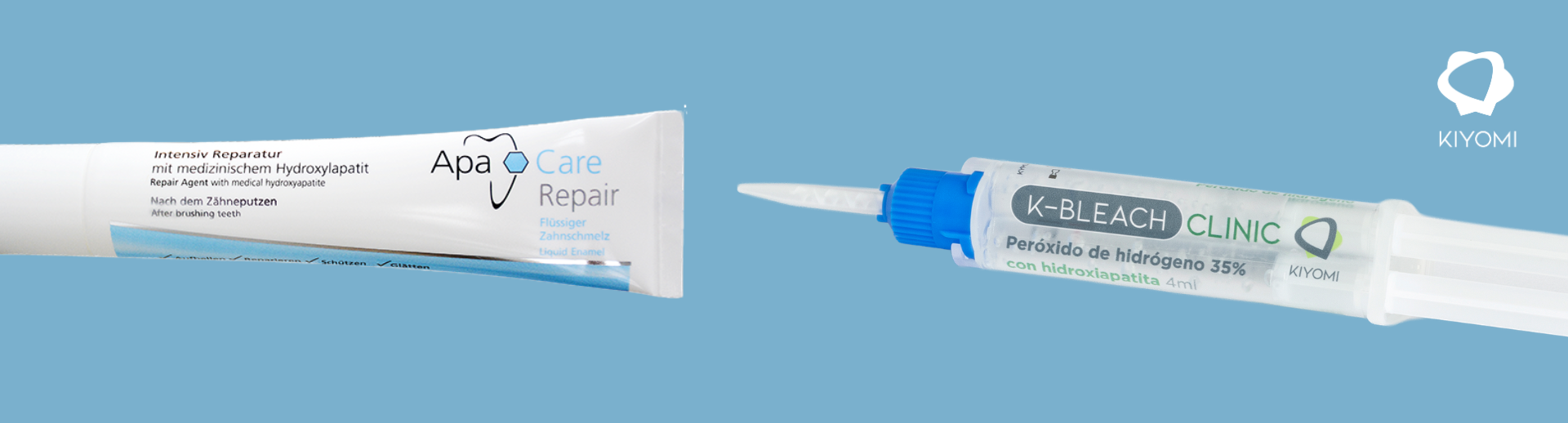
In this context, solutions like ApaCare Repair have gone from being an optional add-on to a key part of the protocol.
Its use allows direct action on the enamel, promoting repair and reducing treatment-related sensitivity. This not only improves immediate patient comfort but also strengthens the dental structure after whitening.
In many clinics, its application before or after treatment has become routine. In fact, fewer and fewer professionals choose not to include it in their protocols.
The result is clear: more comfortable treatments, more satisfied patients, and better overall clinical experience ratings.
Cases where it matters even more: orthodontic patients
There is one patient profile where this approach makes an even bigger difference—those who have undergone orthodontic treatment.
After wearing brackets, it’s common to find:
- areas of hypomineralization
- weakened enamel
- increased sensitivity risk
In these cases, combining orthodontic treatment with a remineralizing approach such as ApaCare Repair, together with the subsequent application of varnish, is not only advisable but essential to ensure a safe and predictable outcome.
Kiyomi whitening systems: visible results with a clinical approach
Within this new paradigm, Kiyomi Dental systems position themselves as a solution aligned with real clinical needs.
It’s not just about achieving whiter teeth—it’s about doing so with control, precision, and respect for dental tissues. Their protocols allow adaptation to each patient, delivering effective results without compromising comfort.
This fits perfectly with today’s trend: smarter, more personalized treatments focused on the patient experience.
The message that changes patient perception.
Today, it’s essential to communicate one clear idea:
Tooth whitening should not hurt.
There are tools, products, and protocols that can prevent sensitivity or reduce it to a minimum. And when patients understand this, their attitude toward the treatment changes completely.
They no longer see it as something they have to “endure,” but as an accessible, safe, and comfortable aesthetic improvement.
Conclusion: the new way to approach tooth whitening.
The rise of aesthetic treatments in spring and summer is a great opportunity for clinics—but also a moment to stand out.
The combination of:
- a high-quality whitening system
- with remineralization protocols like ApaCare Repair
makes the difference between a standard treatment and a high-level clinical experience.
Because in the end, it’s not just about achieving a whiter smile…
it’s about achieving it without sensitivity, without fear, and with total confidence.