

Minimally invasive anterior aesthetic rehabilitation with Aster+ composite from Kiyomi Dental
Clinical precision, biomimicry, and conservative dentistry in a case by Dr. Francisco Monzó
Contemporary aesthetic dentistry has evolved toward a model in which clinical excellence is not measured by the extent of intervention, but by the quality of clinical judgment. Precise planning, respect for biology, and the selection of high-performance materials now make it possible to transform smiles without compromising healthy tooth structure.
This clinical case by Dr. Francisco Monzó clearly represents this modern approach, where technique, diagnosis, and materials work in an integrated way to achieve highly predictable aesthetic, functional, and biological outcomes.
Aesthetic diagnosis and planning
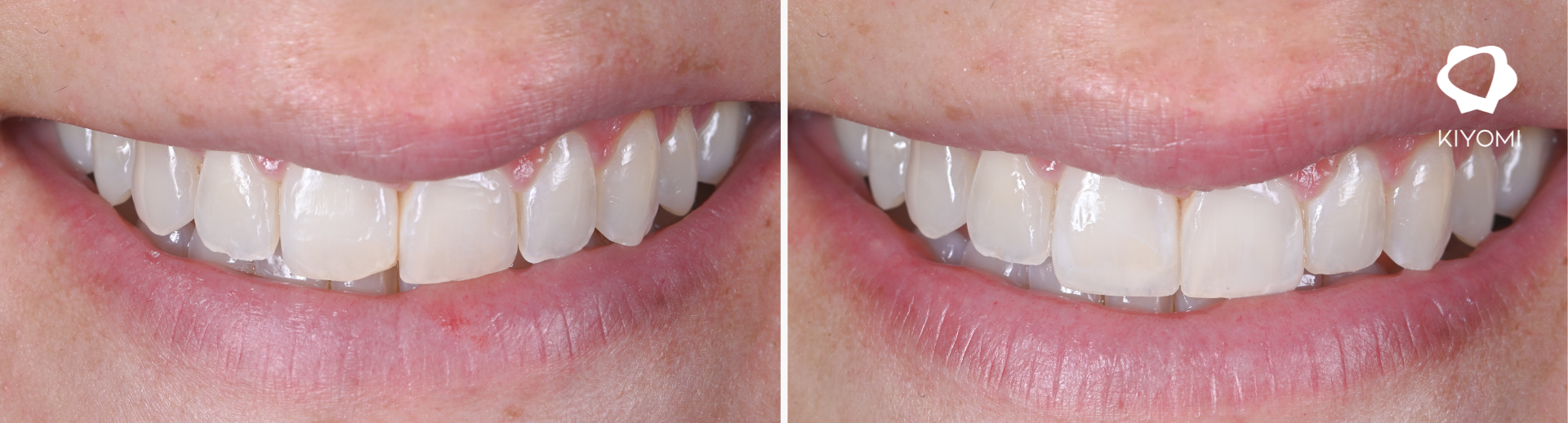
The treatment focused on modifying the canting, correcting the size of the maxillary central incisors (1.1 and 2.1), compensating for their inclination, and harmonising the proportion between both teeth. The clinical objective was to restore anterior symmetry, balance dental proportions, and recover a natural aesthetic, always maintaining a conservative and minimally invasive approach.
The planning allowed for the integration of aesthetics, function, and biology under the principles of biomimetic dentistry, where the restoration not only replicates tooth form but also its optical behaviour and functional integration within the smile.
Restorative clinical protocol
The procedure began with surface conditioning using K-Etch 37% from Kiyomi Dental, an orthophosphoric acid that enables truly selective, precise, controlled, and safe etching. Its exclusive formulation facilitates application, creating an optimal surface for stable and long-lasting adhesion.
Subsequently, the adhesive bonding was performed with K-Bond Universal, a next-generation adhesive system that provides effective chemical and micromechanical adhesion in both enamel and dentin. Its clinical versatility and bond stability make this adhesive a fundamental pillar for the longevity of direct aesthetic restorations.
The reconstruction was carried out using a layering technique with Aster+ composite from Kiyomi Dental, employing high-opacity OA2, medium-opacity A1, and internal characterization with white and indigo tints. This sequence allowed control of translucency, the generation of realistic optical depth, and a natural chromatic integration with the surrounding dental tissue.
The rheological behaviour of Aster+ facilitates precise and stable modelling, enabling the sculpting of a natural dental anatomy with high clinical control and predictability.
The protocol was completed with finishing, polishing, and glossing phases, achieving smooth, stable surfaces resistant to biofilm and a high-level natural aesthetic outcome.
Clinical value of Kiyomi materials
The combination of K-Etch 37%, K-Bond Universal, and Aster+ enables the use of reliable, reproducible, and clinically efficient restorative protocols. These materials provide control, predictability, and durability, facilitating high-quality aesthetic results in minimally invasive direct restorations.
Beyond the visual outcome, the true clinical value lies in adhesive stability, biomimetic integration, and the functional longevity of the restorations.
Modern dentistry: precision, clinical judgment, and minimal invasiveness
This clinical case demonstrates that modern aesthetic dentistry is based on clinical judgment, planning, and precision, rather than overtreatment. Direct composite restorations, when performed with appropriate protocols and high-performance materials such as those from Kiyomi Dental, are established as a highly predictable, conservative, and long-term sustainable solution.
Because in contemporary dentistry, true excellence is not about doing more, but about doing it better.
Kiyomi Dental: materials that support clinical judgment
When the material supports clinical judgment, the result is not only aesthetic: it is biological, functional, and durable. Kiyomi Dental develops solutions designed for professionals who seek control, predictability, and clinical excellence in every procedure.
Because in modern dentistry, real innovation translates into sustainable clinical outcomes and restorations that respect the patient’s biology.