

Modern restorative dentistry is moving towards increasingly conservative treatments. The aim is no longer simply to replace lost dental tissue, but to restore anatomy and function while preserving as much of the remaining healthy tooth structure as possible.
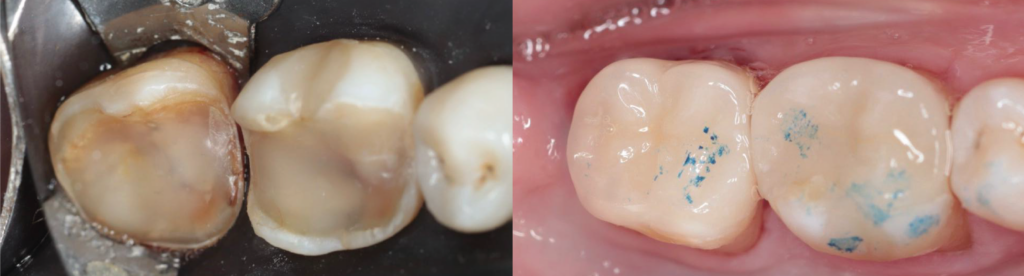
In this clinical case, Dr Víctor Garcías, a specialist in aesthetic dentistry, presents one of the clearest examples of additive adhesive dentistry: restoring lost tooth structure with two ceramic inlays without carrying out any additional tooth preparation. Only minimal preparation was performed along the future junction between the tooth and the restorative material to ensure the correct seating of the indirect restoration and an adequate marginal seal.
To carry out the procedure, Dr Víctor Garcías used an isolation, surface treatment and adhesive cementation protocol consisting of K-Rubber Dam, K-Etch 37%, K-Bond+ Universal, Dual Cem A2 and K-Dam from Kiyomi Dental.
This combination of materials is designed to simplify the different stages of treatment and provide greater control during the adhesive cementation of indirect restorations.
Additive adhesive dentistry: restoring without removing healthy tooth structure
Additive dentistry is based on an essential principle: adding only what has been lost and avoiding the unnecessary removal of healthy dental tissue.
In this case, treated by Dr Víctor Garcías, the clinical conditions made it possible to restore the structure of two teeth with partial ceramic restorations, without the need for additional preparation of the entire remaining tooth structure.
The two inlays were designed to replace only the lost volume, preserving the remaining tissue and restoring the functional anatomy of the teeth.
This minimally invasive approach offers important clinical benefits:
- Preservation of a greater amount of enamel and dentine.
- Reduced removal of healthy tooth structure.
- Restoration of anatomy and occlusal and interproximal contacts.
- Natural aesthetic integration of the restorations.
- Greater respect for the biology and original structure of the tooth.
Not every case can be treated without tooth preparation. The indication must be established after assessing the remaining tooth structure, the available restorative space, the occlusion, the selected material and the patient’s functional requirements.
Absolute isolation with black K-Rubber Dam
The adhesive cementation of ceramic inlays requires precise control of the operating field. The presence of saliva, blood or moisture may interfere with the different stages of the adhesive procedure.
For this reason, Dr Víctor Garcías began the treatment by carrying out absolute isolation with Kiyomi Dental’s black K-Rubber Dam.
The black colour of the dam creates a strong contrast with the tooth structure and ceramic restorations. This makes it easier to visualise the margins, improves control during insertion and facilitates the removal of excess cement.
K-Rubber Dam also provides elasticity and resistance, two particularly important characteristics in restorative procedures where isolation must be maintained for an extended period.
Compared with excessively rigid dams or those offering limited contrast, K-Rubber Dam helps create a cleaner, more visible and better organised working field.
Its main clinical advantages include:
- High contrast with teeth and restorations.
- Good elasticity and adaptation.
- Resistance throughout the procedure.
- Improved visibility of the margins.
- Control of moisture and potential contaminants.
- A more comfortable and predictable operating field.
Controlled dental etching with K-Etch 37%
Following isolation, Dr Víctor Garcías treated the tooth structure with K-Etch 37%, Kiyomi’s dental etching gel formulated with 37% phosphoric acid.
One of the distinguishing features of K-Etch 37% is its thixotropic consistency. The gel remains stable in the area where it is applied, reducing the risk of displacement onto surfaces that do not need to be etched.
This characteristic is particularly useful for partial restorations, selective-etch techniques and areas close to adjacent teeth or difficult-to-access margins.
Its intense blue colour also makes the product easier to identify visually during application and rinsing. Compared with gels that are excessively fluid or difficult to see, K-Etch 37% gives the clinician greater control over the treated area.
Its main benefits include:
- 37% phosphoric acid.
- Thixotropic consistency.
- Precise and controlled application.
- Highly visible blue colour.
- Stability on enamel and dentine.
- Compatibility with total-etch and selective-etch techniques.
- Easy removal by rinsing.
K-Bond+ Universal: versatility within the adhesive protocol
Once the etching stage had been completed, Dr Víctor Garcías applied K-Bond+ Universal, Kiyomi’s universal dental adhesive indicated for direct and indirect restorations.
Its formulation contains optimised MDP, a functional monomer that promotes chemical interaction with dental tissues and complements the micromechanical retention achieved during surface treatment.
K-Bond+ Universal can be used with different adhesive strategies:
- Self-etch technique.
- Selective enamel etching.
- Total etching of enamel and dentine.
This versatility allows the protocol to be adapted to the requirements of each preparation without the need to use a different adhesive for each technique.
Compared with adhesive systems limited to a single clinical strategy, K-Bond+ Universal offers greater flexibility and can be incorporated more easily into different restorative procedures.
In Dr Víctor Garcías’ case, K-Bond was applied without light curing before the placement of Dual Cem A2 resin cement, in accordance with the selected clinical protocol for cementing the inlays.
Application, evaporation and light-curing times must always be adjusted in accordance with the instructions for use of each material.
Cementation of the inlays with Dual Cem A2
The two ceramic inlays were cemented using Dual Cem A2, Kiyomi Dental’s dual-cure resin cement.
Dual-cure cements combine light activation, or photopolymerisation, with a chemical curing mechanism, or self-curing. This characteristic is particularly relevant for inlays, onlays, overlays and other indirect restorations where the thickness or opacity of the ceramic may reduce light transmission.
Whereas a purely light-cured cement depends entirely on the light energy passing through the restoration, Dual Cem provides a complementary chemical curing mechanism.
This offers greater reliability in deep areas or areas that are less accessible to the curing light.
Dual Cem is supplied in a dual-barrel syringe that mixes the base and catalyst at a 1:1 ratio. The automixing system produces a homogeneous consistency and reduces potential errors associated with manual mixing.
It is indicated for the cementation of different restorations and materials:
- Inlays, onlays and overlays.
- Endocrowns.
- Crowns and bridges made from zirconia, lithium disilicate, porcelain-fused-to-metal, hybrid materials, composites and other materials.
- Cementation of glass fibre posts.
- Deep margin elevation.
- Fabrication of biobases.
- Cementation of implant interfaces.
In this case, Dr Víctor Garcías selected shade A2 to promote the optical integration of the inlays with the tooth structure and prevent the cement line from affecting the final aesthetic result.
Compared with materials that depend exclusively on light or require manual mixing, Dual Cem stands out for its:
- Dual-cure polymerisation.
- Automatic mixing at a 1:1 ratio.
- Homogeneous consistency.
- Good handling characteristics.
- Availability in aesthetic shades.
- Versatility for different indirect restorations.
- High radiopacity to facilitate clinical monitoring.
K-Dam: greater control when handling small restorations
One of the most delicate stages of this treatment was treating and transferring the small ceramic inlays to their final position.
Partial restorations can be thin, small and difficult to hold. Dropping one during handling may contaminate the previously treated surface, interrupt the protocol or even damage the restoration.
To prevent this, Dr Víctor Garcías used the high thixotropy of Kiyomi Dental’s K-Dam as a support to temporarily stabilise the inlays.
K-Dam is a light-cured gingival barrier designed to provide complete or partial isolation of the gingival tissue. Its consistency enables it to remain stable in the area where it is applied without running, maximising the blockage of fluids from entering the treatment area.
In the dentist’s own words, the small restorations rest on the K-Dam as though they were “little embedded flowers”, making their surface treatment and handling easier.
This application made it possible to hold the partial restorations without fear of dropping them and to transfer them to their dental beds with greater safety, precision and ergonomics.
The benefits observed during the procedure included:
- Stabilisation of small inlays.
- Greater safety during surface treatment.
- Reduced risk of dropping or contaminating the restorations.
- Easier handling.
- Improved working position.
- More controlled insertion.
- Greater ergonomics throughout the procedure.
This complementary use corresponds to the clinical technique developed by Dr Víctor Garcías in this case and does not replace the indications for use established by the manufacturer.
What does the Kiyomi Dental restorative protocol offer?
The value of the protocol used by Dr Víctor Garcías does not depend solely on the individual performance of each product.
Its main distinguishing feature is the possibility of addressing different stages of treatment using materials from the same restorative dentistry range:
- K-Rubber Dam provides isolation, resistance and contrast.
- K-Etch 37% enables precise and controlled etching.
- K-Bond+ Universal offers versatility across different adhesive strategies.
- Dual Cem A2 provides dual curing, automixing and aesthetic integration.
- K-Dam facilitates isolation and the handling of small restorations.
Compared with combining products with very different handling characteristics, the Kiyomi protocol aims to provide a simple, visual and consistent workflow.
This enables the clinician to focus on the most important aspects of the treatment: restoration fit, margin control, seating, excess removal and final aesthetic integration.
A clinical case based on maximum preservation
The case treated by Dr Víctor Garcías demonstrates that restoring a tooth does not always mean removing more dental tissue.
When clinically indicated, adhesive dentistry makes it possible to restore anatomy through a completely additive strategy: preserving the healthy remaining structure and adding only what is necessary.
The two ceramic inlays restored the shape and function of the teeth without excessive additional preparation that could increase the likelihood of fracture of the tooth or restorative material.
Isolation with K-Rubber Dam, etching with K-Etch 37%, the application of K-Bond+ Universal, cementation with Dual Cem A2 and the handling of the restorations with K-Dam made it possible to carry out a controlled procedure focused on maximum preservation.
A different way of understanding restorative dentistry:
less removal of dental tissue, greater adhesion and more respect for the natural structure of the tooth.
Kiyomi Dental materials for adhesive cementation
Are you looking for a dual-cure resin cement for inlays, a universal dental adhesive, a 37% dental etching gel or a black rubber dam for restorative dentistry?
Discover Kiyomi Dental’s restorative range and check the availability of K-Rubber Dam, K-Etch 37%, K-Bond+ Universal, Dual Cem and K-Dam at IPG Dental.