

In aesthetic dentistry, a good result should not look like a restoration. It should blend into the smile until it becomes practically indistinguishable from the natural dentition. Based on this principle, Dr. Víctor Garcías presents a new clinical case involving the reconstruction of the anterior teeth using products from Kiyomi Dental.
“If you do it, let it look natural!”
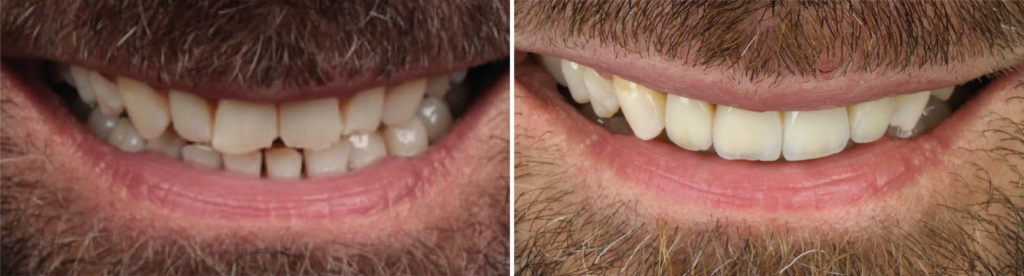
This philosophy guides an intervention in which small changes make it possible to achieve a significant improvement. Using the Dahl Plateau technique, the treatment restored function in the anterior region and gave the smile a balanced appearance, while respecting the natural shades of the patient’s dentition.
The challenge: restoring function and natural aesthetics in the anterior region
Aesthetic reconstruction of the anterior teeth presents a dual challenge. On the one hand, proper function must be restored and, on the other, the restorations must blend naturally into the smile and the overall facial appearance.
For Dr. Víctor Garcías, reproducing what nature created is a constant pursuit. This means studying every detail of the case: shape, colour, proportions, texture and the functional relationship between the teeth.
In this treatment, the aim was not to completely transform the smile, but to intervene conservatively in order to restore what had been lost:
- A proper functional relationship in the anterior region.
- Greater harmony between the teeth and the face.
- Shades consistent with the natural dentition.
- An aesthetic result without an artificial appearance.
Functional restoration using the Dahl Plateau technique
The Dahl Plateau technique made it possible to reconstruct the anterior region and restore the so-called envelope of function. This concept refers to the space and movements made by the mandible during functional activities such as speaking or chewing.
This approach facilitates the planned restoration of the anterior region, creating the conditions required to re-establish occlusal balance. The shape of each restoration is not determined solely by aesthetic criteria: it must also integrate correctly with the patient’s mandibular dynamics.
This combination of functional planning and aesthetic restoration was essential to achieving a stable, harmonious and natural result.
Pre-restorative tooth whitening with K-Bleach Clinic and K-Bleach Home
Before beginning the restorative phase, Dr. Víctor Garcías carried out a combined tooth whitening treatment using K-Bleach Clinic and K-Bleach Home by Kiyomi Dental.
Preliminary whitening was a non-negotiable stage of the treatment plan. By initially lightening the dentition, it was possible to establish a more favourable colour base and subsequently select the restoration shades with greater precision.
The protocol combined:
- K-Bleach Clinic, designed for in-office tooth whitening.
- K-Bleach Home, designed to continue or complement the treatment at home under professional supervision.
The coordinated use of both products makes it possible to integrate the in-office and at-home phases within the same protocol. This approach is particularly useful when whitening forms part of a broader aesthetic rehabilitation rather than being an isolated treatment.
The key advantages of the K-Bleach system
Unlike solutions focused solely on lightening tooth colour, the K-Bleach system is designed to integrate easily into a complete aesthetic treatment plan.
K-Bleach Clinic 35% contains 0.1% nano-hydroxyapatite and vitamin E, together with a formulation designed to limit tooth dehydration. Its consistency facilitates application and allows the product to be removed easily, contributing to a more comfortable and controlled procedure for the clinician.
Meanwhile, K-Bleach Home 16% makes it possible to extend the treatment beyond the dental practice while following the dentist’s instructions. The combination provides the versatility needed to personalise the protocol according to the patient’s starting point and aesthetic goals.
Isolation of the working field with K-Dam
During adhesive and whitening procedures, control of the operating field is essential. In this case, K-Dam by Kiyomi Dental was used to protect the soft tissues and properly delimit the treatment area.
The light-curing gingival barrier facilitates precise application and helps the clinician work more safely. Its key advantage lies in how easily it can be integrated into the clinical protocol, allowing localised protection to be created exactly where it is needed.
Proper isolation not only contributes to patient protection. It also improves control over the procedure and allows the clinician to focus on each stage of the treatment.
Adhesive preparation with K-ETCH 37%
The integration of anterior restorations depends to a large extent on a properly performed adhesive protocol. For conditioning the dental surfaces, K-ETCH 37%, Kiyomi Dental’s phosphoric acid etchant, was used.
Its thixotropic behaviour enables controlled application, helping prevent the material from spreading unnecessarily into other areas. This characteristic is particularly relevant in the anterior region, where precision during etching helps protect the tissues and ensures that only the intended surfaces are conditioned.
In addition to providing uniform etching, its formulation facilitates product removal. In this way, K-ETCH 37% delivers control and simplicity during a decisive stage of the bonding procedure.
Bonding with K-Bond+ Universal
After conditioning the surfaces, K-Bond+ Universal, Kiyomi Dental’s universal adhesive, was used.
Its MDP-containing formulation allows it to be integrated into different adhesive protocols and used in a wide variety of restorative situations. Its universal nature helps simplify inventory and makes it easier for clinicians to adapt the technique to the needs of each case.
Another of its distinguishing characteristics is its colourless appearance. In anterior restorations, where any colour alteration can influence the final result, having an adhesive that does not interfere visually helps facilitate the reproduction of a natural aesthetic.
A Kiyomi protocol designed to make clinical work simpler
One of the main advantages of the products used in this case is that they do not function as isolated solutions. K-Bleach Clinic, K-Bleach Home, K-Dam, K-ETCH 37% and K-Bond+ Universal form part of a coherent protocol designed to address different stages of aesthetic-restorative treatment.
This integration provides clinical advantages such as:
- Greater continuity between whitening and restoration.
- Protocols that are easier to organise.
- Controlled application and handling.
- Compatibility between different clinical stages.
- Greater attention to the final aesthetic result.
- Solutions designed to simplify the dentist’s everyday work.
While many products on the market address a specific need, the Kiyomi Dental approach aims to simplify the treatment as a whole. Clinicians can work with materials developed according to the same philosophy: achieving predictable, effective procedures that are easy to incorporate into everyday clinical practice.
The result: a functional, harmonious and natural smile
The result of this clinical case demonstrates how a carefully planned intervention can produce a significant change without altering the identity of the smile.
The Dahl Plateau technique made it possible to restore function in the anterior region, while the Kiyomi Dental protocol helped prepare the tooth colour, protect the tissues and carry out the adhesive stages with precision.
The selection of shades matching the patient’s own dentition provided the final harmony required for the face. The goal was not to create a standardised smile, but rather a personalised result that reproduced the variation and natural appearance of real teeth.
The case by Dr. Víctor Garcías reflects an essential principle of contemporary restorative dentistry: achieving a significant result by intervening only where necessary, while making the outcome look as though it were created by nature.