


Dental composite resins are among the most widely used materials in restorative dentistry thanks to their versatility, aesthetics and ability to adapt to different clinical situations.
However, there are different types of composite resin, and understanding their differences is important when choosing the most suitable material for each restoration.
What types of composite resin are available?
Composite resins can mainly be classified according to the size and distribution of their filler particles.
Microfilled composite resins
They stand out for their polishability and good aesthetic performance, which is why they have traditionally been used especially in the anterior region.
Hybrid and microhybrid composite resins
They combine particles of different sizes to provide a balance between strength, aesthetics and ease of handling. They are versatile materials that can be used for different types of restorations.
Nanohybrid composite resins
Nanohybrid composite resins combine nanoscale particles with larger particles. This makes it possible to achieve a good balance between mechanical strength, polishability and aesthetics.
Because of their versatility, they are currently one of the most interesting options for professionals looking to buy dental composite resin for both anterior and posterior restorations.
This category includes Aster+ by Kiyomi Dental, a nanohybrid composite resin designed to integrate easily into routine restorative procedures.
Flowable composite resins
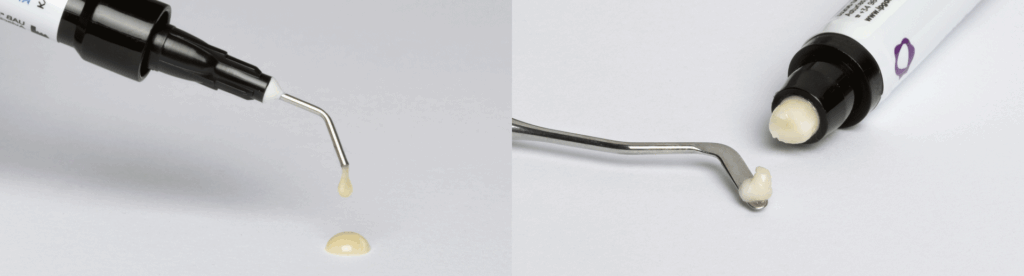
Flowable composite resins have a lower viscosity, making them easier to adapt to small cavities, hard-to-reach areas or certain minimally invasive procedures.
For these indications, solutions such as Aster Flow+ by Kiyomi Dental can complement the use of a conventional composite.
Bulk-fill composite resins
Bulk-fill composites are designed to allow thicker increments than conventional resins, provided that the manufacturer’s instructions are followed.
They are particularly used in certain posterior restorations where the aim is to simplify the application technique.
What is the best composite resin for dental restorations?
There is no single best dental composite resin for every case.
The choice will depend on factors such as:
- The location of the restoration.
- Aesthetic requirements.
- Masticatory forces.
- The desired viscosity.
- Polishability.
- The application technique.
However, nanohybrid composite resins are currently among the most versatile alternatives, as they offer a good balance between aesthetics and mechanical performance.
For this reason, they are often a common choice when looking for a professional dental composite that can be used for both anterior and posterior restorations.
Which composite resin should be used for anterior teeth?
In anterior restorations, aesthetics, polishability and the integration of the material with the natural tooth are particularly important.
Nanohybrid composite resins can provide a good combination of aesthetic and mechanical properties for this type of treatment.
And for posterior restorations?
In the posterior region, wear resistance and performance under masticatory loads become more important.
In these cases, it is advisable to choose a composite resin for posterior restorations that is specifically indicated for this type of treatment and offers suitable mechanical properties.
Conventional composite or flowable composite?
Both can complement each other.
A conventional composite provides greater control during restoration modelling, while a flowable dental composite can facilitate adaptation in certain areas.
For this reason, many dental clinics choose to have both types of composite available as part of their restorative protocol.
What should you consider when buying dental composite resin?
Before you buy dental composite, it is advisable to consider aspects such as:
- Type of composite resin.
- Clinical indications.
- Filler content.
- Handling.
- Polishability.
- Shade range.
- Compatibility with the adhesive system.
Brands such as Kiyomi Dental offer different solutions for integrating composite materials into restorative protocols, with products such as Aster+, Aster Flow+, K-Bond+ Universal and K-ETCH 37%.
The final choice should always be based on the type of restoration and the clinical requirements of each individual case.