

Biomimetic restoration with DVO increase: clinical case using Aster composites and K-Bond Universal adhesive system +
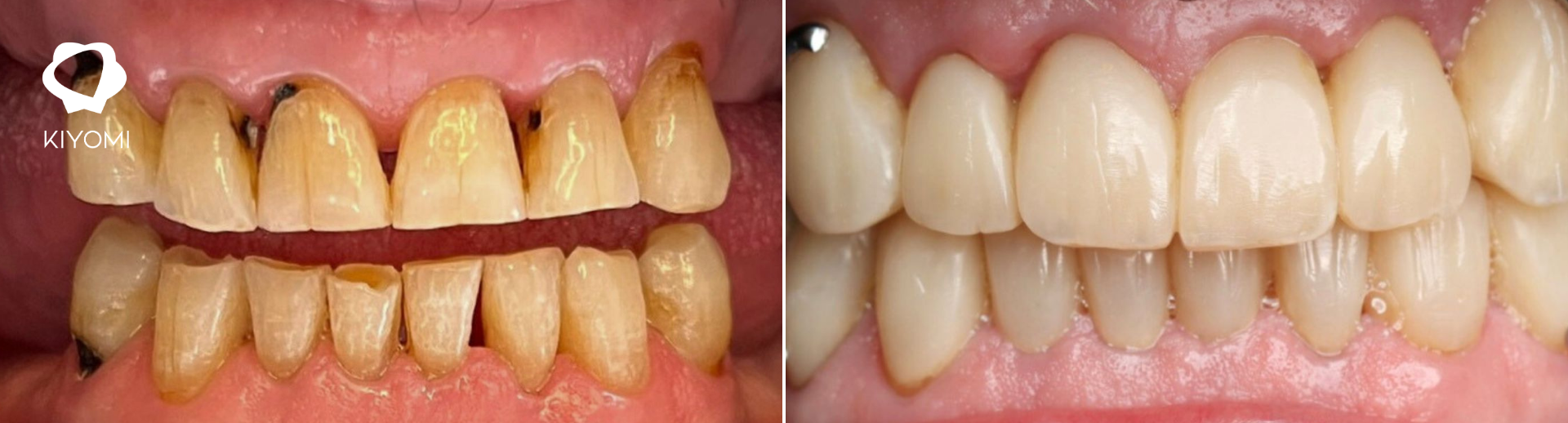
In this article, we present a clinical case carried out by Dr. Victor Garcías from Garcias & Pereira Clínica Dental, in which the aesthetic and functional rehabilitation of both dental arches is addressed through direct adhesive restorations using Aster composites from Kiyomi Dental and the K-Bond Universal+ adhesive system. The objective was to restore the vertical dimension of occlusion (VDO) and achieve a natural, stable, and biomimetic result.
Diagnosis and planning: key to functional rehabilitation
The treatment began with a diagnostic wax-up in the anterosuperior sector (13 to 23), which allowed the design of an ideal anatomy for both palatal and vestibular surfaces. This step was essential to anticipate the final outcome and establish a slight but effective increase in vertical dimension, a key factor for the patient’s occlusal and neuromuscular stability.
Upper restoration: enamel and dentin bonding with K-Bond Universal+
The first restorative phase consisted of the rehabilitation of the six upper anterior teeth. Aster composites from Kiyomi Dental were used, following a standardized adhesive technique on enamel and dentin with K-Bond Universal+, a system known for its high adhesion and clinical versatility.
After the restoration, the patient was maintained for one week in the new VDO to allow progressive neuromuscular adaptation before continuing with the lower arch treatment.
Lower restoration: continuity in technique and materials
Next, the eight lower teeth were treated, respecting the newly established vertical dimension. The same adhesive protocol was repeated, ensuring complete isolation and the use of K-Bond Universal+ to maintain consistency in the technique and maximize the clinical longevity of the restorations.
This restorative phase left the patient ready for the prosthetic stage, including trials of the planned removable metal framework.
Layering technique with dual-opacity composites
To achieve a natural and biomimetic effect, a layering technique with two opacity levels was used:
- Aster Enamel EA1 (A1) on the buccal and palatal surfaces.
- Aster Dentin in the central area to provide the ideal chromatic support.
The remaining tooth structure was preserved as much as possible, removing only caries-affected tissue. In niches or areas with limited access, Aster Flow A2 was used, allowing for precise and safe application in difficult-to-reach spaces.
Aesthetic finishing: subtle and biomimetic characterization
The final step was aesthetic characterization using subtle stains in ochre, white, and blue tones, adding depth, vitality, and individualization to each restoration.
Conclusion: predictable and functional results without complications
Thanks to careful planning, the use of state-of-the-art materials such as Aster and K-Bond Universal+ from Kiyomi Dental, and a rigorous adhesive technique, Dr. Victor Garcías achieved a full-mouth restoration that not only improved the patient’s aesthetics but also ensured stable occlusal function and successful neuromuscular adaptation.
This clinical case demonstrates how restorative dentistry can deliver natural, long-lasting, and biomimetic results when science, technique, and high-quality materials are combined.